Travel
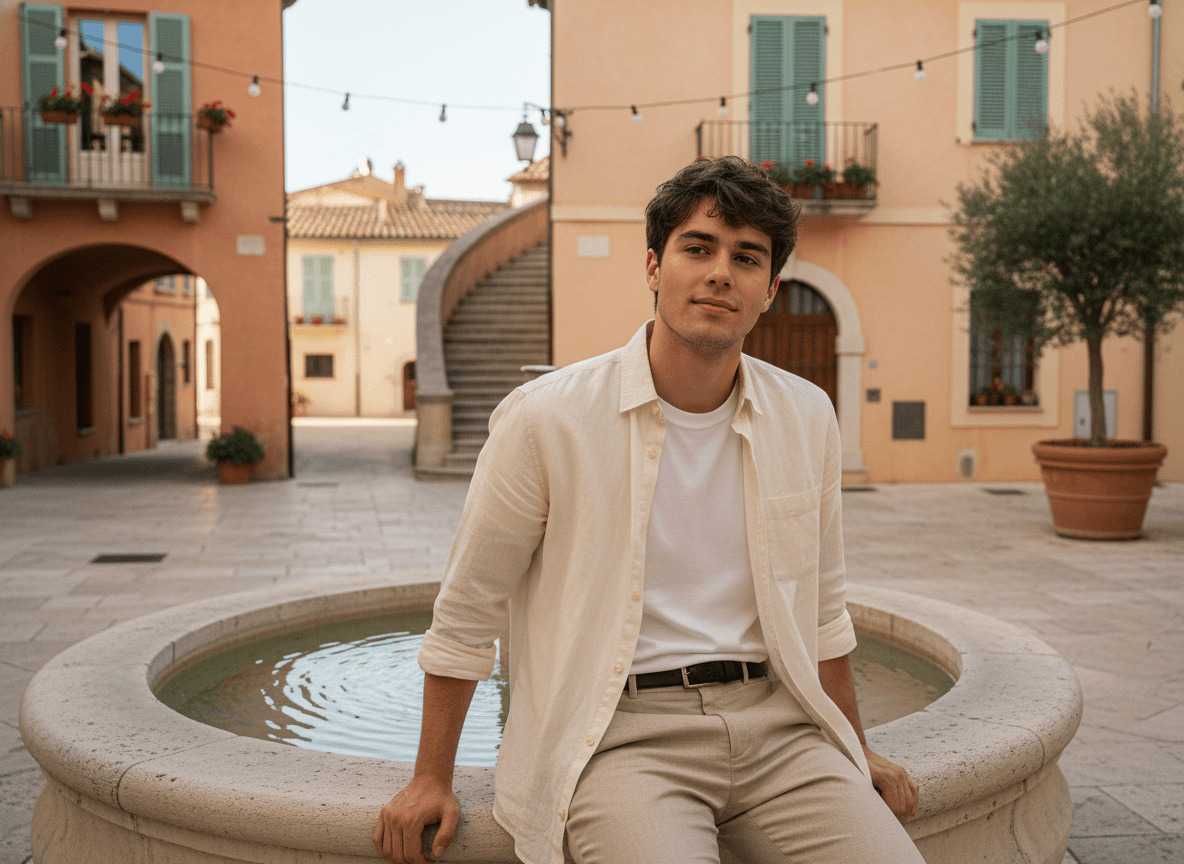
A portrait on an old-town square in warm morning light.
Before and after
When a travel photo for dating works
A travel dating photo is one of the strongest frames in any profile. On Tinder, Bumble and Hinge it instantly creates a hook for the first message: "where was that taken?" or "where's your next trip?" It signals that you're curious, open and don't sit still — and that lands faster than any bio could.
The style helps if your gallery is mostly city selfies and lacks that sense of a "different life" outside the work routine. Our AI travel photo generator takes your selfies and in a couple of minutes builds a portfolio in the spirit of Condé Nast Traveler or Monocle — a neural photoshoot without the photographer, the plane tickets or the hotel.
What you'll get on your photo
A quiet pedestrian square in a Mediterranean old town, around ten in the morning. Underfoot — light limestone with a soft natural patina, a few smooth-worn cobblestones along the edges. In the center — a low stone fountain with a round basin, water rippling quietly without jets. Around the perimeter — low historic buildings in terracotta and cream tones, tall arched windows, faded wooden shutters in muted blues and teals, wrought-iron balconies with red geraniums in pots, narrow archways into side alleys, gentle stone steps in the distance. Along a wall — an olive tree in a large terracotta pot, a string of bulbs hanging between buildings overhead. Far away — terracotta roofs and a clear pale-blue sky.
You're wearing a loose cream linen shirt with a relaxed straight cut, sleeves rolled to mid-forearm, top two buttons undone, fabric showing natural texture and soft folds. Underneath — a simple white crew-neck t-shirt, sand-beige linen straight pants and clean white low-top sneakers. A small canvas crossbody bag in stone-grey hangs over one shoulder, no logo. No watch, no bracelets, no glasses on the face — hands empty, silhouette calm. The skin keeps its natural texture: this AI travel portrait doesn't turn faces into plastic masks or push the colors into postcard territory.
Lighting is soft morning sun from the upper left, with a warm bounce off the cream facades on the right. Color treatment in the spirit of Fujifilm Classic Chrome: muted warm tones, gently lifted shadows, no HDR. The pose and expression shift from frame to frame: a walk across the square in one, a rest on the fountain steps in another, a close-up by the olive tree in a third.
How the travel photo generator works
To generate a quality travel photo, upload 3–5 front-facing selfies, choose how many shots you want — and wait a couple of minutes. From there the AI generator takes over: it analyzes your facial features, places them onto the Mediterranean square, and builds the portfolio in three steps.
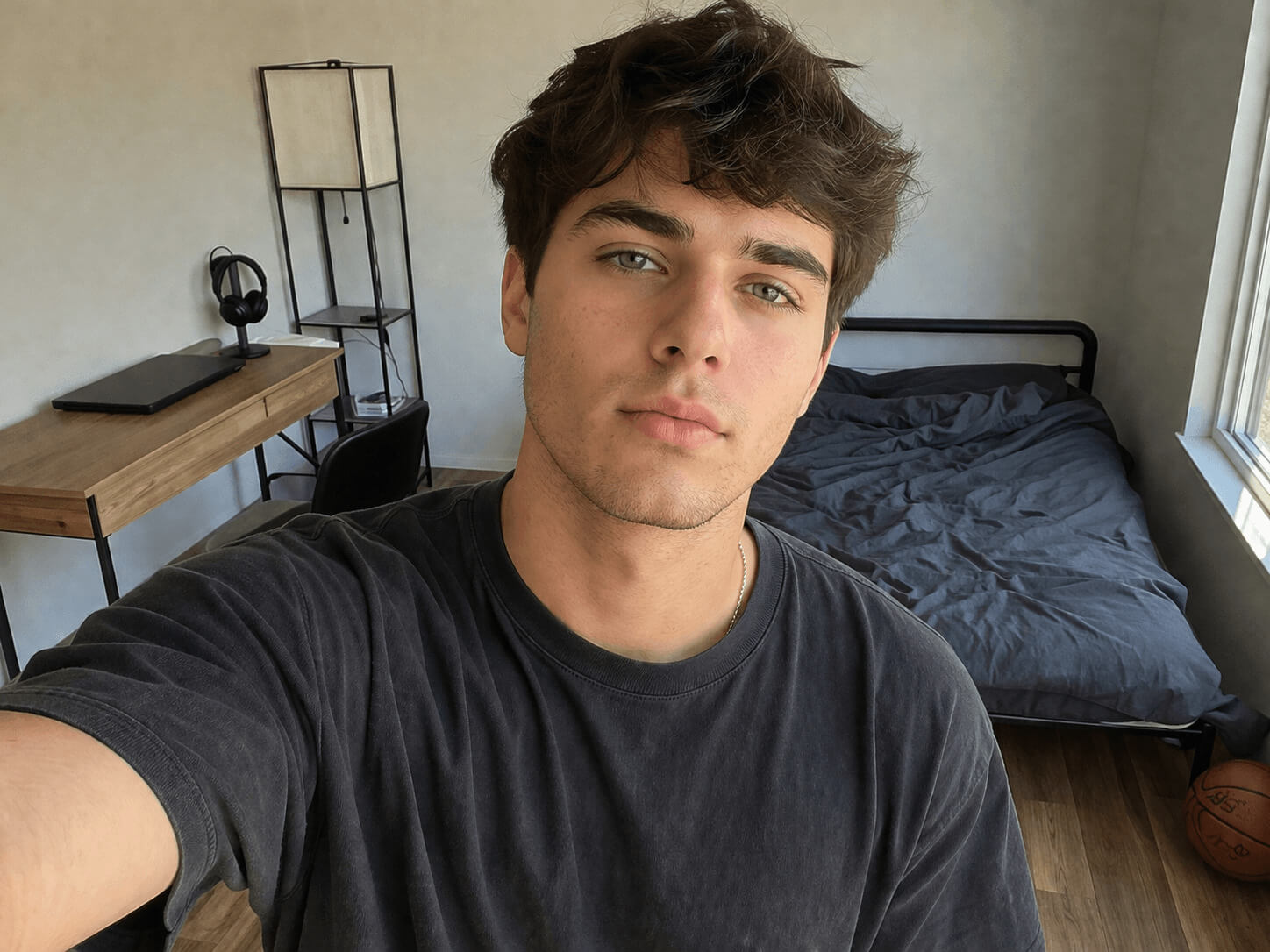
- Upload up to 5 front-facing selfies in daylight — face fully in frame, no glasses or caps. The clearer your features, the more accurately the AI keeps your likeness under warm street light.
- Choose how many photos you want in the style — starting from 1 shot. Each travel shot costs 20 credits, and the total pack price is calculated automatically.
- Wait a couple of minutes. Generation usually takes 2–4 minutes; during peak hours, up to 10. Once your pack is ready, you'll get a notification and can download any photo at full resolution.
Where to use it: Tinder, Instagram, travel blog
A main or second photo on Tinder, Bumble and Hinge — especially if you're looking for a partner you can travel with. An AI travel photo works as a contrast to a business or home shot: it shows another context of your life, not just another selfie in the same room.
Beyond dating, this kind of shot lands well on Instagram (especially as a "Travel" highlight cover), on a travel blog, as a Telegram-article preview, or as an avatar on Booking, Airbnb or Couchsurfing. It's an editorial frame without the travel budget — handy when you need to refresh your feed between real trips.
Selfie tips for the best result
The quality of your input decides the quality of the final frame. Dark selfies or shots with harsh backlight throw off the model: the face "burns out" or falls into shadow, and the AI starts inventing features instead of preserving them.
- 3–5 front-facing selfies, face in focus and fully in frame.
- Daylight from a window or soft shade outside — no direct sun.
- No dark glasses, caps, masks or thick scarves.
- Different angles: straight-on, a slight head turn, a touch from above and a touch from below.
- A clean background, no other people or bright text.
Related styles
If old-town architecture feels too "urban," try an outdoor photo on a mountain trail or a beach portrait at sunset — both convey the same trip mood. For a premium combo, add a night-city shot: the "morning old town + evening downtown" pair fills out a dating-app gallery without a single real trip.